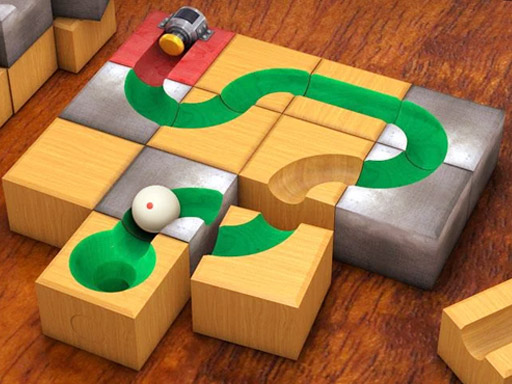
This is a rolling block puzzle, listed under a descriptive title but known elsewhere as Let Me Roll. Each level presents a ball and a small field of tiles, and the aim is to get the ball to its destination by rearranging the ground it travels over. The tiles are the puzzle rather than the ball. Wooden tiles can be slid around the field and carry a path across their surface; iron tiles are fixed and cannot be moved at all. Solving a level means sliding the movable tiles into an order that forms an unbroken route, working around the fixed ones that get in the way. It is closer to a sliding tile puzzle than to a maze - the ball's journey is the confirmation that you solved it, not the challenge itself. There is no timer and no failure state, so a level ends only when you complete it or leave, which puts the whole weight of the game on reading the board correctly.
How to Play Sliding block, brain, rolling puzzle
Drag or click a wooden tile to slide it into an empty space on the field. Iron tiles are fixed and will not move. Arrange the movable tiles so their paths connect into a continuous route from the ball to the goal, then let the ball roll through to complete the level.
Tips and Tricks
Work backwards from the goal. The tile that has to sit next to the destination is usually forced, and fixing it first removes most of the guesswork from the rest.
Treat iron tiles as walls that shape the solution rather than as obstacles to work around. Their positions tell you which routes were never possible.
Count the empty spaces before you start sliding. A field with one gap allows only one tile to move at a time, which restricts the order of your moves severely.
If a route looks right but will not connect, check the direction of the path drawn on each tile rather than just its position. A correctly placed tile facing the wrong way is the most common cause.
Frequently Asked Questions
What is the difference between the wood and iron tiles?
Wooden tiles slide and carry a path the ball can travel along. Iron tiles are fixed in place, cannot be moved, and exist to constrain which arrangements are possible.
Can I fail a level?
No. There is no timer and no limit on moves, so a level continues until you solve it. The only cost of a wrong arrangement is undoing it.
Is it a maze game?
Not really. The ball's route is the result rather than the challenge - the actual puzzle is arranging the tiles that form the route in the first place.
Do the levels get harder?
Yes. Later stages add more fixed tiles and fewer empty spaces, which restricts the order in which you can move things and makes the sequence itself part of the problem.
Does it work on a phone?
Yes. It runs in the browser on GN Math and the tiles respond to dragging on a touchscreen as well as to a mouse.
Tags
sliding puzzle, rolling ball, brain game, logic puzzle, tile puzzle, thinking game, single player, browser game, no download, level based
 ▶
Play
▶
Play