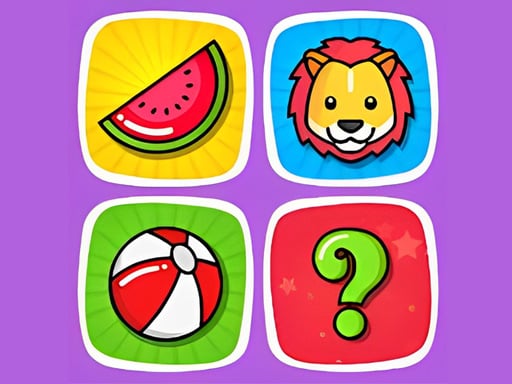
Memory Match Game is the card-pairing exercise most people met as children, rebuilt for a browser. A grid of face-down cards hides pairs of matching pictures. Turn two over: if they match they stay up, and if they do not they flip back and you try again somewhere else. What makes it worth playing past childhood is that it is a genuine test of one specific skill - short-term spatial memory - with nothing else mixed in. There is no dexterity involved, no timing, no strategy beyond remembering what you saw. That purity is also why it stays difficult. Most people can hold five or six card positions comfortably and start losing them at eight or nine, which is exactly where the larger grids sit. Playing well means being disciplined about how you explore rather than trying to remember harder: turning cards in a fixed order gives your memory a structure to hang on to, while flipping at random gives it nothing.
How to Play Memory Match Game
Click or tap a face-down card to turn it over, then turn over a second one. Matching cards stay face up; non-matching cards flip back after a moment. Clear the whole grid by finding every pair. Larger grids simply add more pairs rather than changing the rules.
Tips and Tricks
Turn cards in a fixed order - left to right along each row - rather than at random. A sequence is far easier to recall than a scatter, and you will stop revisiting cards you have already seen.
When you turn up a card you cannot pair, say what it is and roughly where it sits before moving on. Naming a thing makes it noticeably easier to retrieve than simply looking at it.
If you know one card of a pair, hunt for its partner immediately rather than banking it for later. Memories of card positions decay fast once you start turning other cards.
Do not rush the early turns. The opening exploration is what the rest of the round depends on, and time saved there is lost several times over in repeated flips.
Frequently Asked Questions
What age is this suitable for?
Almost any. Young children manage the small grids comfortably, and the larger ones are a real test for adults. Nothing has to be read and there is no time pressure.
Is there a timer?
No. You can take as long as you like on each turn, which keeps it a memory exercise rather than a test of speed.
Does the grid size change?
Yes. Larger grids hold more pairs, which is what raises the difficulty - the rules stay identical throughout.
Does this actually help memory?
It exercises short-term visual memory while you play. Claims about lasting improvement from games like this are not well supported, so it is best treated as an enjoyable exercise rather than training.
Can I play it on a tablet?
Yes. Memory Match Game runs in the browser on GN Math and the cards respond to taps as well as mouse clicks.
Tags
memory game, matching game, card game, concentration game, brain game, kids game, puzzle game, single player, browser game, no download
 ▶
Play
▶
Play